O'Connell St, Hutt St, and the question of who our streets are really for?
Who has the right to be in, make use of, and have a say in shaping the future of our streets as public spaces? ‘Everyone’ is the answer I’d like to hear, but we know that isn’t the case. For example, if we examine the first part of the question even briefly, ‘who has the right to be in our streets’, it becomes apparent that the experience of me as a cis white adult man simply existing on any given street will be very different to that of someone who appears to be very young, or a woman, or of a non-dominant ethnic group. Especially, say, at night. It’s a fascinating subject that others have written a lot on, and someday I might too. But today I wanted to approach this topic from the frame of cycling, and in doing so hope to shed light on just some of the value systems and power relations that govern the way our streets are used.
In the past year I have been involved in advocating for more inclusive, more accessible and more successful outcomes for two of the main streets in Adelaide city: O’Connell St and Hutt St. Both are major commercial streets that aren’t as thriving as they have been or could be, and as such were earmarked for re-imagination under the City of Adelaide’s ‘Main Streets Revitalisation’ program. In both cases, a long period of multiple rounds of community consultation arrived at basically the same conclusion: new designs for each street that invested space in wider footpaths for people walking, outdoor dining, trees and greenery and continuous, separated cycle lanes along their length. People recognised that a successful street was one that welcomed and provided space for more groups of people, not just those driving cars. And yet, in both cases, a last-minute pushback from powerful business owner groups and their politician and media allies resulted in community consultation being overturned and the ‘revitalisation’ projects being watered down to essentially new pavers and lighting. No wider footpaths, no increased outdoor dining, and certainly no continuous, protected bike lanes.
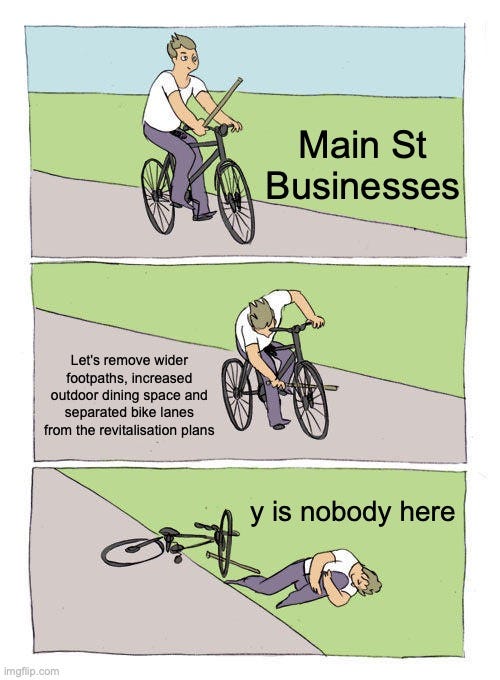
One comment I heard time and again from those speaking out against the people-focused revitalisation projects was the sentiment that main streets like O’Connell St and Hutt St were just not the places to be riding a bike. The cyclists had a perfectly good bike path a couple of streets over - why couldn’t they be riding there? Naturally I was frustrated to hear this. I wrote about this in my last post, where I espoused my preference for quiet cycling-first streets over dedicated, separated bikeways. But as I was writing, something was gnawing at me. Isn’t advocating for a network of safe, quiet streets for cycling really just a slightly more palatable way of pushing people on bikes away out of sight so that the uncomfortable question of who our streets our really for (and why they aren’t for everyone) doesn’t have to be asked? Once again, the paper I read from Bonham and King gets right to the heart of this thorny issue:
The constant reference to ‘quiet’ places raises suspicions about the bike rider that uses ‘busy’ streets. Further, as ‘residental’ and ‘local’ streets are identified as appropriate sites for cycling, those who ride along shopping and commercial streets can be called into question.
To state it another way, O’Connell St and Hutt St are for sensible, normal people in cars, not for weirdos on bikes - at all. Indeed, what we saw happen with these streets was the orchestrated and overwhelming crushing of the (community supported) attempt to question and renegotiate the status quo of power relations on the street themselves. Designs that would have made these streets more accessible to a larger group of people by making walking and cycling more convenient, more pleasant and safer were swept away in favour of the status quo whereby priority access is given to people who drive. It must not be forgotten that ‘people who drive’ is not everyone: if you’re too young, too old, too poor or too different in ability then driving a car is quite literally impossible.
I’ve been reflecting on the vicious way in which both of these projects were neutered at the last moment. I think that the overwhelming concentration of traditional forms of power (business, media, politicians) that united to oppose the people-centred components of these projects shows that a nerve was struck. After all, the changes proposed in both Hutt St and O’Connell St should not have been controversial in the slightest: in both cases they were in line with widely-consulted-on city strategic documents recognising the need to reallocate street space away from cars and towards people, supported in multiple rounds of community consultation, and endorsed by elected members at formal council meetings. The normal process was followed; a process that was side-stepped, ignored and made irrelevant by those opposing the projects.

What I am trying to say is this: we (I) think and hope that our streets are for everyone, including people who choose to cycle. Enough people believe this that policies and projects that take steps to make our streets more inclusive are routinely supported when the community is consulted. And yet, what O’Connell St and Hutt St show is that who our streets actually are for, at least now, with this current Adelaide City Council, is business owners. We have seen that this group of people has the power to overrule regular democratic process when their perceived interests (i.e. driving everywhere by car) are threatened.
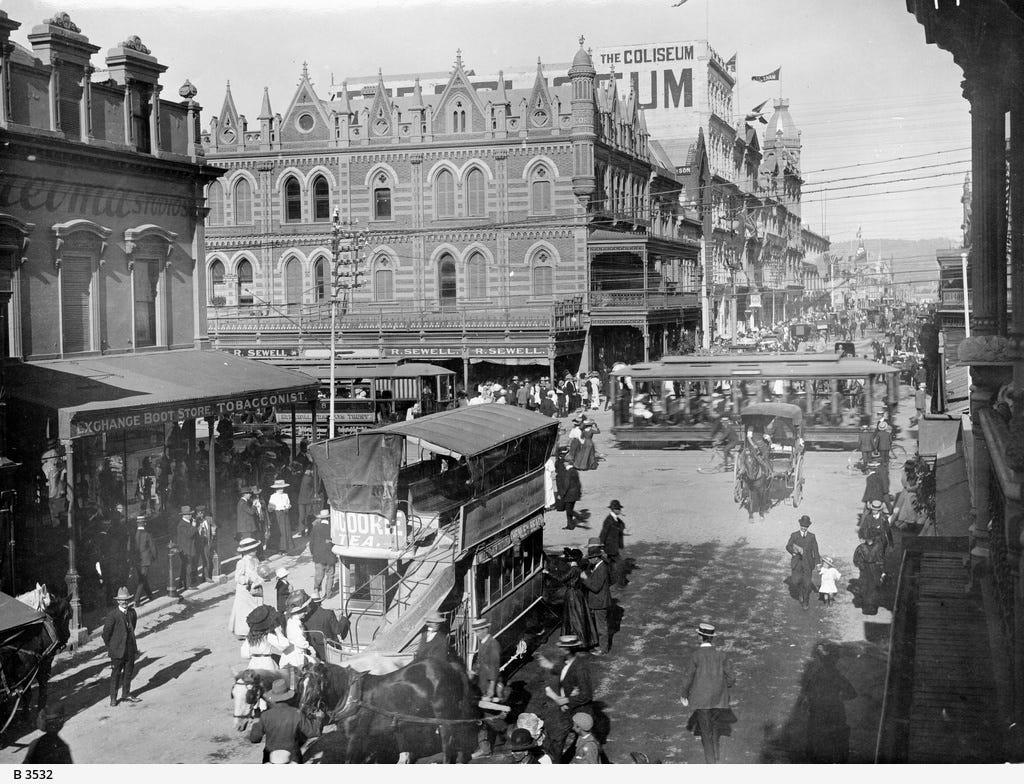
So where does that leave the cyclist, or indeed anyone who hopes for public spaces that are truly for everyone? Well, for one we can look to places that are not Adelaide, or even not Adelaide now, to remember that it doesn’t always have to be this way. In Sydney, the busy, car-choked George St I remember from 10 years ago was transformedinto a pedestrianised public transport boulevard. And the streets of Adelaide itself used to be places where people on foot, bike, horse, tram and car shared the space far more equally than they do now.
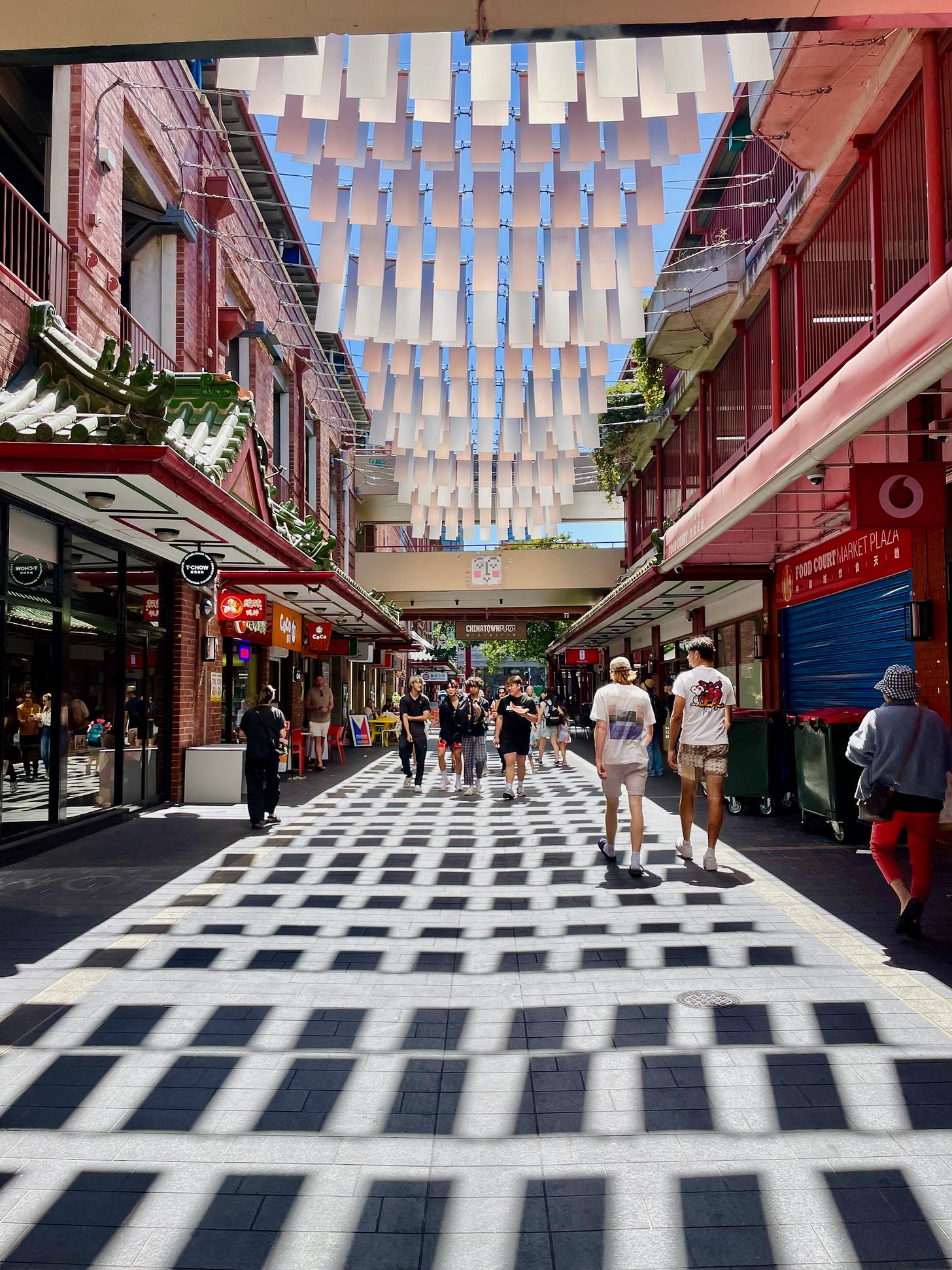
If travelling interstate or back in time isn’t you’re thing, a living example of a thriving, people-first main street can be found right here in Adelaide by heading over to Gouger St in Chinatown. There, you will find what is probably the busiest part of the city on any given night. You’ll see how when council has vision to open up streets to pedestrians (Moonta St), invest street space in people (Field St), and prioritise people on foot (the zebra crossing in front of the gates), streets come alive.
Recognising the systems of power that control our streets is an important first step to renegotiating the right of people on bikes (and others) to exist on our public streets. By questioning, challenging, circumventing, coopting - in short, engaging with these systems of power, real change can be made. The examples - in Adelaide, and elsewhere, show this change is not just desirable, but possible.
Comments ()